
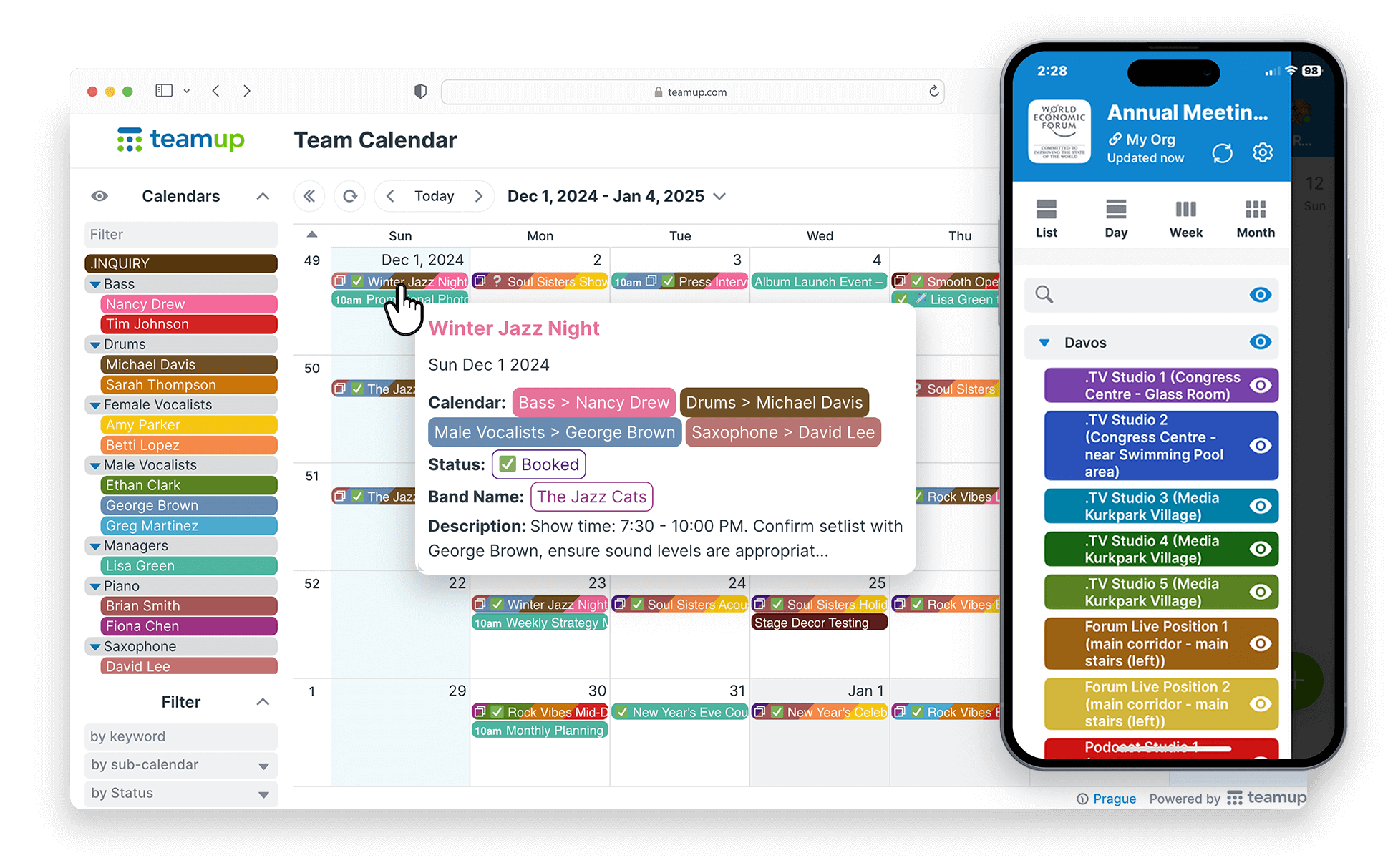
Managing resources, spaces, and schedules is a time-consuming responsibility. The more people and options involved, the more complex the task becomes. One common issue is the “bottleneck syndrome.”
A single person holds the responsibility for managing the information, making decisions, and overseeing inputs. As a result, everyone else involved–from colleagues to clients–has to wait for this individual to process all information and make decisions.
You can avoid this type of scenario by setting up smart systems, delegating, and enabling everyone involved to do the work needed. Less waiting, more efficiency, and a better process all around: read on for more ideas and use cases.
Appointment and space booking
Overseeing reservations for appointment slots, meetings, and spaces can range from very simple to very complex. For simple booking situations, when you need to make a few spaces or time slots available to a limited number of clients, Teamup is a great tool.
- Show Availability and Enable Self-Booking for Shared Gym Spaces
- A Shared Calendar for Tennis Court Self-Booking
- Make Availability Visible and Enable Self-Booking with a Shared Calendar
- Book Shared Lab Equipment with Group Usage Tracking
Special event bookings
Booking appointments or spaces may not be a regular part of your workload. Perhaps you’re coordinating a special event, conference, trade show, or other big project. In these cases, you need a system that is flexible enough to meet the demands of the event, accessible for everyone involved, and intuitive for users.
- How Teamup Supports Media Bookings at World Economic Forum
- Manage Short-Term, Granular Bookings in Scheduler View
Prevent booking issues
Some common issues and problems come up in booking situations. With a little proactive prevention, many of these issues can be avoided.
- Avoid the information bottleneck: prevent information and communication from slowing up by delegating and decentralizing. When there is only one person who “knows the system,” everything depends on that one person. A better approach is to set up a secure system that is easy to use for many participants. Empowering others to do their own booking means less frustration for everyone.
- Require booking approval first: you may wish to enable others to do their own booking, but certain details need to be reviewed and approved first. If that’s the case, you can set up a simple approval process that lessens the workload without allowing unapproved bookings to “go live.”
- Prevent double-booking: a nightmare scenario for any event or space coordinator, double-bookings cause a host of problems and are messy to fix. The best cure is prevention. Learn how: Automatically Prevent Overlapping Events
- Missed booking opportunities: it’s frustrating to realize you’ve missed a booking or opportunity because you weren’t able to respond quickly enough. A shared booking system–and one that’s available on mobile–can make it easier to coordinate schedule, make decisions, and book the right opportunities as they arise.