Project management is complex: multiple contributors, shifting project timelines, lots of information, and continual updates. All the factors can make communication and collaboration quite the challenge. Project management software needs to be both flexible and powerful enough to meet the challenge.
Spreadsheets as project management software
Spreadsheets can handle some aspects of project management. They provide a space to dump all the information.
But what isn’t easily solved by spreadsheets? Everything else.
It’s difficult to sort, filter, create unique views, keep data secure, allow collaboration, exert version control, and set permission levels.
Sometimes you need a client to see the information but not be able to do anything with it. How do you do that with a spreadsheet? You create a PDF and email it. But wait: just as you send the email, you realize something is off, adjust the column, and now you have to create another PDF and email the newest version.
What if you could grant your client access to your live, updated view of the project timeline, but without allowing them to change anything? They can see what’s happening—the most recently updated version and information—without messing any of it up.
Teamup Calendar as project management software
Let’s look at how you can set up a project management timeline with an interactive, secure, easily managed Teamup calendar.
Calendar features
First, a quick look at the main Teamup Calendar components:
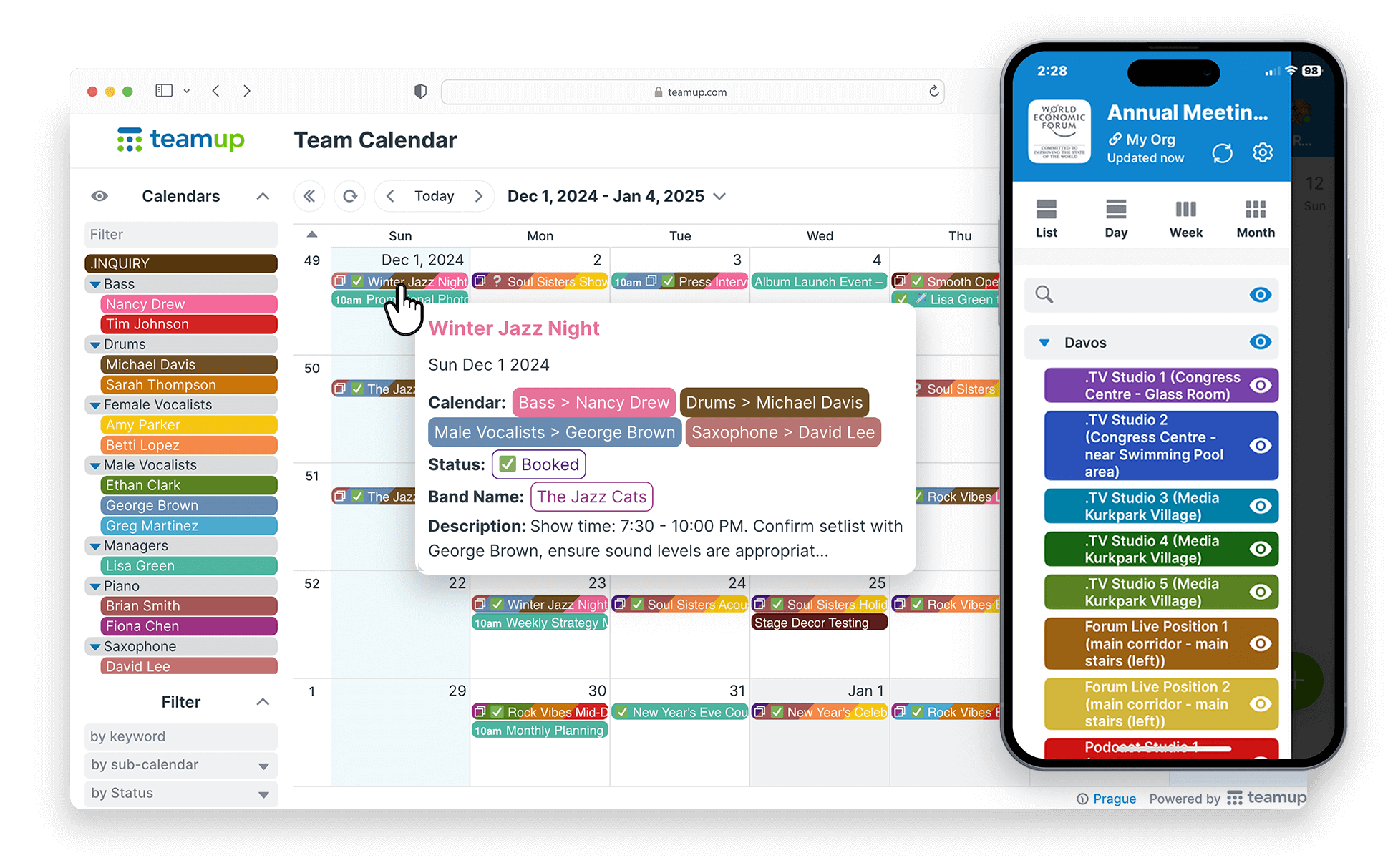
- Sub-calendars: Your Teamup master calendar can contain multiple, color-coded sub-calendars. The sub-calendars can be organized in folders. You can turn individual sub-calendars and entire folders on and off from the calendar view.
- Calendar views: View your project management timelines and details in multiple calendar views, from standard Day, Week, and Month to flexible Scheduler, Multi-week, and Year.
- Custom event fields: Create your own custom event fields to capture and sort key information. If desired, show the contents of a custom event field in the event title.
- User access: Easily control who can access your project management software calendar, and what they can do. Add your team as calendar account users and choose which sub-calendars each user can access, with appropriate permissions.
Creating a project information hub
Projects can range from simple to complex, with timelines from a few weeks to many months. Some projects only require a few team members, while others will have entire departments plus outsourced contributors involved. And, as the project progresses, there will be more and more information, links, documents, and discussions created.
So, before you create a project timeline or start assigning tasks, set up a project info hub. This can be a single event on your Teamup project calendar. You can set it to repeat so it shows up every Monday, for example, or at the beginning of every month, so it’s always easy to find.
Add links to all the initial project documentation, from briefs to client contact info to design guidelines. Instruct team members to keep the project hub updated as new assets are created. The amount of back-and-forth frustration you create with this one move will make everyone more productive. No need to ping a coworker for a link or the latest version of a document. It’s all in the project hub — keep it open as an event page in a browser tab for easy reference anytime.
Setting up a project timeline
One of the first tasks in project management is setting up a preliminary timeline. Excel spreadsheets are often used as project timeline templates. Here’s how you could set up a project timeline with a Teamup calendar.
Set up the calendar
First, you’ll create a folder for the project timeline. This will hold any sub-calendars related to the project timeline and keep your calendar view easy to manipulate and organize.
This project has three phases, so you create a sub-calendar for each phase. Now you can add events—spanning hours, days, or weeks—for each major milestone of each phase.
Viewing the timeline
Timeline view shows your project in a timeline, right on your calendar: The Timeline View
Year view is also really helpful here. You can set the number of months you want to view. If the project starts on the first of February, you can set your Year view to begin on February 01 and show the needed number of months.
You can see where the phases begin and end and overlap. This helps you see where potential bottlenecks might occur. Need to move an event? Drag and drop it, or click to edit the date.
Keeping the project timeline updated
Now you have a clean project timeline view.
The color-coded sub-calendars make it easy to see what’s happening in each phase, at a glance. As the project begins, you can adjust events as needed. Everyone who views the project timeline will always see the most updated version: no information conflicts, and no need to continually save and share the newest version. The project timeline will stay updated automatically for everyone who views or uses it.
Related resources: