
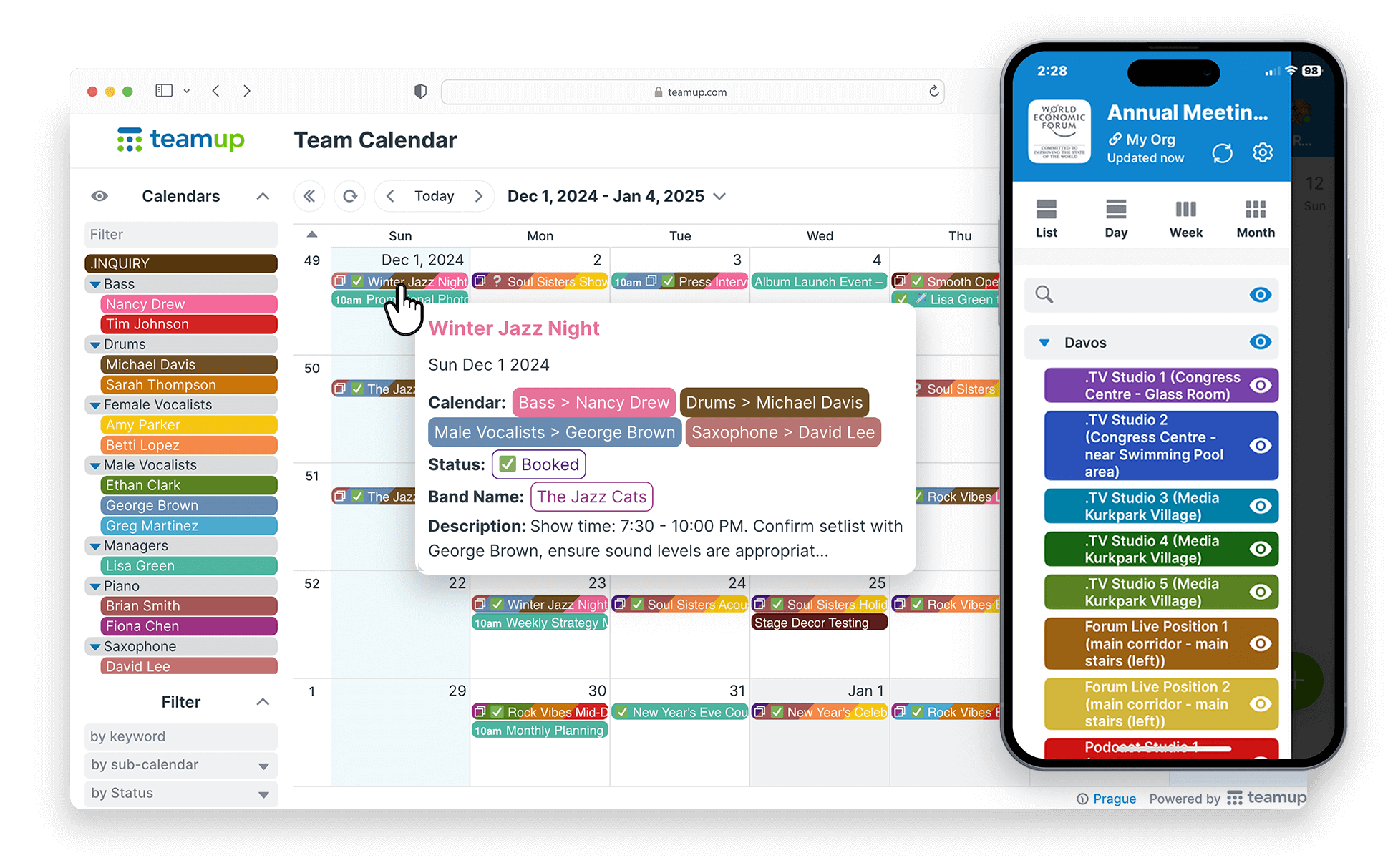
When you think about how to make a business calendar, start with the structure. Most companies are organized in teams or departments that focus on specific areas of work, such as engineering, production, sales and finance. In small businesses, it is also common that some people wear multiple hats and work in more than one department. When you create a business calendar, structure it by operations or roles to get a clear overview of who is doing what. To keep an eye on availability of resources, create a work calendar structured by resource types or locations.
What a company calendar can do
If you would like to create a company calendar where all employees can update their vacation plans and be scheduled for jobs, while everyone may or may not view the calendars of others, you’ve come to the right place.
Teamup allows you to set up such a company calendar easily. The case below demonstrates how to create the company calendars and give appropriate calendar access to each employee. Managers can be granted broader calendar access to keep informed of what’s up for a whole department.
Case background:
- The company has 25 employees. They are split within 2 departments:
- Department 1: 16 employees
- Department 2: 14 employees
- There are 5 employees working in both departments.
(If you do not have employees working in multiple departments, the solution is even simpler.)
The need as described by the manager who is looking for a solution:
“I would like to have the possibility to have 3 different type of views for the people in different roles in my company.”
- One calendar view to include ALL 25 sub-calendars. This is the calendar access needed for the company owner and other key personnel.
- One calendar view for the manager of Department 1 which regroups 16 individual calendars; one calendar view for the manager of Department 2 which regroups 14 individual calendars.
- One calendar view for each individual employee so that people can look at their calendar only and update if needed.
When granting calendar access to individuals in your organization, you control the sub-calendars included and the level of access permission for each sub-calendar. This way, you can create different “calendar views” which show only the included sub-calendars appropriate for each person. The calendar “views” are really customized access, set up precisely for each user so they see what’s relevant to their role and have the appropriate permissions.
More guides here:
- 5 Practical Tips to Set Up a Shared Team Calendar
- Share Your Calendar Securely with Customized Access Permissions
- Get Started with the Teamup App
Create a business calendar
Think about how to make a business calendar in terms of the purpose and the people. The purpose is what the calendar is for, how it helps the company achieve its goals and fulfill its primary functions. The people, of course, are the ones who make it all happen. When you create a work calendar with Teamup you can customize how each user accesses the calendar. Every person has the information they need to do their job well. It’s more efficient and more secure:
- An individual employee is able to update her own calendar but only view the calendars of others.
- Optionally, if the employee would like to read his or her calendar from their personal calendar, like Google Calendar or Outlook, they could subscribe to the iCalendar feed of their Teamup Calendar.
- To overcome delays of the refreshing frequency of the destination calendar, one may consider setting up email notifications so that you will be notified when changes occur on your Teamup Calendar.
One consideration when you create a work calendar is getting all the information in one place. Remember that Teamup can also be the destination calendar: One can pull in an external calendar like a Google Calendar to the Teamup Calendar by using our inbound iCalendar feeds functionality. Both options are one-way and read-only sync, meaning the subscribed calendars can not be edited on the destination calendar.