When Spreadsheets Can’t Scale for Large Staff Schedules

As your business grows with a second location, an extra crew, or just more people to manage, the way you operate has to evolve, too. Putting together a simple schedule for a few team members is doable on a spreadsheet. But as things get more complicated, the old spreadsheet starts to drag. For streamlined scheduling and operations, you need a more flexible tool.

Why spreadsheets fail for complex schedules

Spreadsheets were never built for real-time collaboration at scale. As the team grows, so do the headaches. Every new person adds more rows, more color codes, more chance of error. Scrolling and filtering become a chore, and it’s all too easy to overlook a gap in the schedule or a double-booked team member.

A spreadsheet seems like it has structure. And it does, in a way: A grid of rows and columns. But it’s not a flexible structure. It’s tough (if not impossible) to layer in the scheduling factors and dependencies that become important. You can add another spreadsheet tab, but that still doesn’t bring everything together in one place.

How a scalable shared calendar solves it
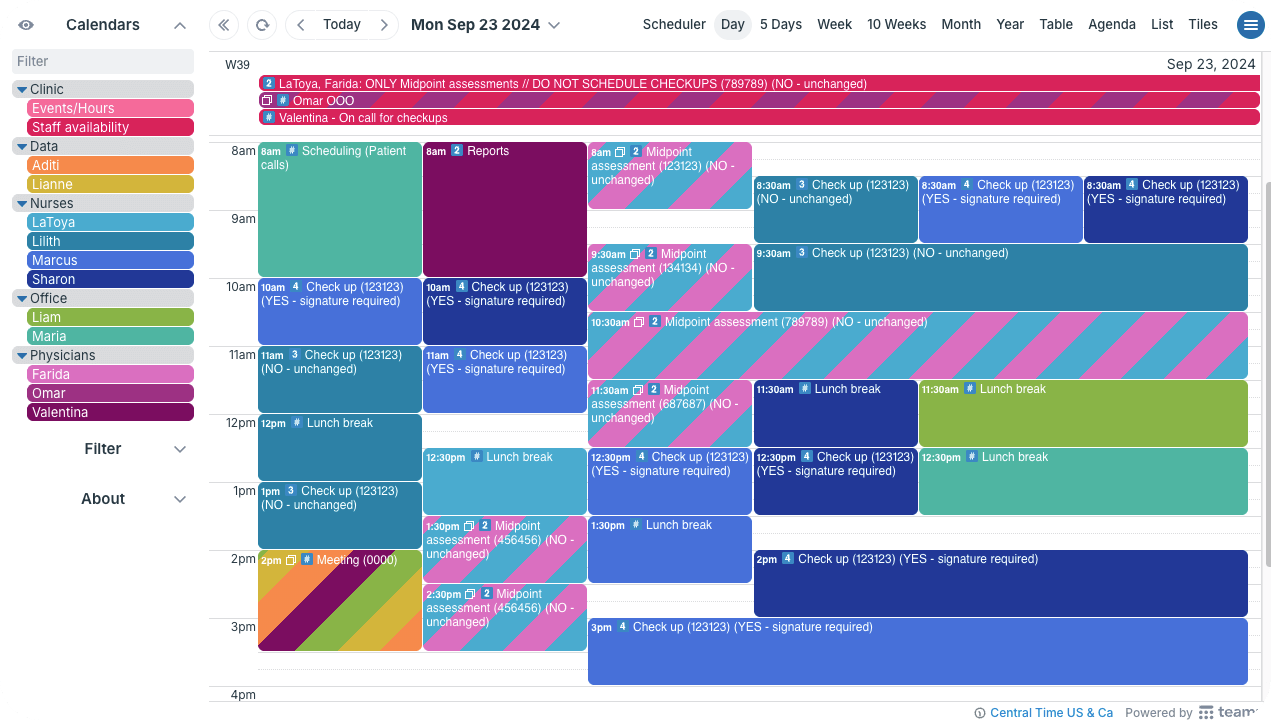
A smarter approach: A single shared calendar built for groups, flexible enough to handle complexity without slowing down.

See what matters

Imagine working with a tool that displays each team member or resource as its own sub-calendar. Sub-calendars are color-coded, organized in folders, and instantly filterable. Plus, you can toggle which ones are in view. Need to see all the pieces? Toggle on all the sub-calendars and zoom the date range out. Need to focus on one team, shift, or project? Narrow down your view by adjusting the date range and hiding any calendars that aren’t relevant at the moment.

Set up customized access

You can control who sees what, so team members view only their own schedules without being overwhelmed by everyone else’s. And with real-time syncing across devices, any update from the office or field appears instantly for everyone.

And everyone can access the same real-time view from any device, so updates are easy and sync everywhere.

How to set it up
⚙️ Mini-guide

  1. Create sub-calendars for each team member, resource, or location.
    Organize them in folders.
  2. Color-code for clarity. Assign distinct colors to each sub-calendar so coverage and overlaps are obvious at a glance.
  3. Prevent conflicts. Configure each sub-calendar to automatically stop overlapping events.
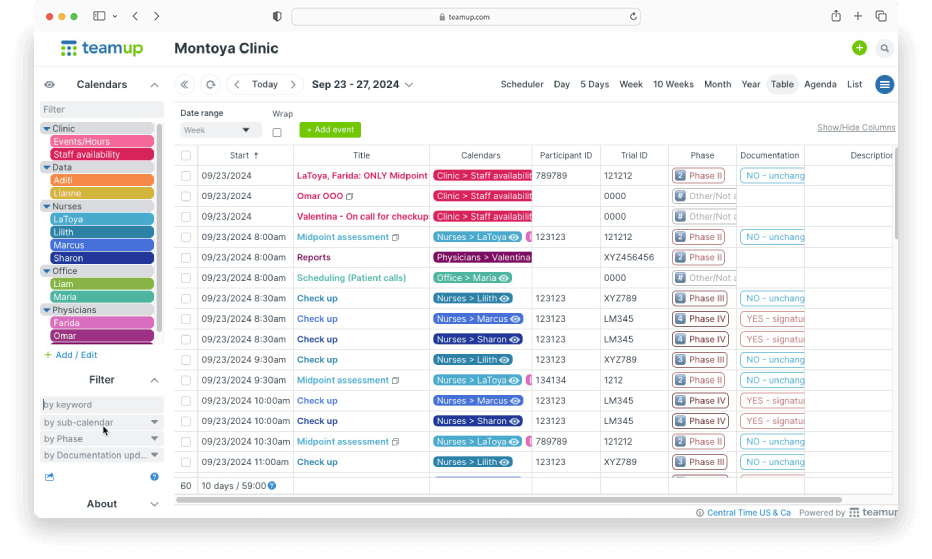
  4. Find the right view. Move from Timeline to Table, Multi-day to Year, to see what’s relevant. Zoom in or out as the task demands.
  5. Toggle and filter. In the left sidebar, toggle sub-calendars on/off. Use the Filter field to sort by keyword or custom field.
  6. Share the right access. Add each team member as a user with customized access permissions set up precisely for their role.
  7. Stay synced with the Teamup app. Check the schedule anywhere.

Get a handle on complexity

You don’t have to wrestle with slow spreadsheets to keep your team organized. Switch to shared calendar that can scale with you. As your business expands, add more calendars to keep things organized. No hassle, no disruption, no new tabs or hidden errors. Just clear scheduling with visual layouts, secure access, and automatic syncing. Get started today.


Color-Coding for Smarter Scheduling: A Cleaning Service’s Story

Color-Coding for Smarter Scheduling: A Cleaning Service’s Story

Client projects rarely stay within one team. A single delivery often spans multiple departments, each using its own tools and processes. Design creates concepts and assets in their design tools, development tracks build work in a sprint board, QA manages testing in their own environment, and customer success coordinates onboarding on a separate timeline.

Each team is doing solid work. But no one sees the whole project as it moves forward. As a result, project managers spend time chasing updates from every department and trying to piece together what’s happening. With Teamup, project managers can create a unified calendar structure to coordinate complex, multi-department client projects with full transparency, fewer surprises, and smoother delivery.

Why cross-team visibility matters

When every department tracks its work in its own system, the overall project timeline becomes fragmented. This leads to issues such as:

Work stalling because a dependent task hasn’t started yet
Shared people or resources getting double-booked
Milestones drifting without early warning

Project managers constantly need to update status between teams just to keep everyone aligned. But with a shared timeline, everyone can easily see: Who is doing what, when their part starts, which tasks depend on others, when handoffs occur, which deadlines are at risk. With one shared calendar, the full delivery timeline is visible at a glance, improving coordination and efficiency across all teams.

A combined project calendar with departmental sub-calendars

In Teamup, you can build a unified project calendar that keeps everything visible while giving each department the appropriate access permissions. Each department works in its own sub-calendar and manages its own updates, while the full project rolls up into one timeline for the project manager.

Click to enlarge: A Teamup project calendar showing color-coded sub-calendars per department

For a closer look at how access levels and information visibility across internal teams, see how to Get Cross-Team Visibility with the Right Amount of Information Sharing.

The benefits of a unified project calendar
For project managers
Gain the oversight they need without chasing updates.
Easily spot delays, conflicts, or bottlenecks.
Share filtered, read-only views with clients and stakeholders.
For departments
See how their own schedule fits into the bigger project timeline.
Improve collaboration across teams with clearer, shared context.
Facilitate handoffs by having visibility into upstream and downstream work.
For leadership
Gain a high-level view of how the project is progressing across departments.
Spot broader risks and capacity constraints earlier.
Enable clearer, more reliable long-range planning.
Example: A cross-department project timeline in a shared calendar

Many client projects follow a sequence such as Design, Development, QA, Customer handoff, and Launch. In a unified shared calendar, the entire sequence becomes visible in one place.

For example: Design can schedule concepts, wireframes, and approval cycles. Development can block time for implementation and internal reviews. QA can add testing windows and verification steps. At the end, Customer Success can schedule onboarding or handoff activities.

With all of these phases shown together in a single timeline, it becomes much easier to understand dependencies, spot risks early, and ensure each team is ready for the next handoff —  keeping the entire project moving forward smoothly.

Click to enlarge: Design team Scheduler view. The lock icon next to the other department sub-calendars shows that events in other departments’ calendars are visible, but Read-Only

Ready to try a unified project calendar for your own team? Explore our live demos or create your own Teamup calendar.

WordPress Cookie Notice by Real Cookie Banner