For years, planning content at the New Zealand Herald was like solving a puzzle. You couldn’t see the whole picture. Each department — news, sports, business, and entertainment — worked in isolation. These silos made collaboration difficult. Coordinating across departments was time-consuming and tedious, costing precious efficiency. But failing to coordinate caused priority issues, scheduling conflicts, and poor use of resources. Andrew Laxon, a senior editor at the organization, knew something had to change.
The Challenge: Disconnected organizational silos
The New Zealand Herald, part of New Zealand Media and Entertainment, is the most widely read newspaper in New Zealand and publisher of New Zealand’s largest news website reaching more than 2 million Kiwis monthly.
Andrew Laxon leads the planning team at NZ Herald that plays a crucial role in this large media organization. In this connected world, people now can get news from anywhere. On top of live news and breaking news, having planned exclusive content that people will pay for has become ever more strategic for media organizations like NZ Herald.
In a recent conversation, Andrew shared with us how Teamup plays an important part in content planning at NZ Herald.
No overview of organization-wide activity
Before Andrew discovered Teamup, the newsroom faced a significant challenge: they lacked a unified system to manage editorial planning. Each department had its own workflow and tools, contained in a silo system. For example, the news department had their Trello board, sports had theirs, entertainment had theirs: All separate, with no means of connecting pieces across the departments.
This siloed system showed team members only what their own department was doing, on their own board. Each department had little visibility into what others were doing. The resulting missed opportunities and inefficiencies took valuable time and focus away from this fast-moving organization.
To see what was going on, you had to jump between the different boards. If you were a senior editor or the editor of the whole Herald, and you wanted to know what we were actually doing on any given day or week across news, sports, business, and entertainment, you couldn’t actually see it.
Scheduling conflicts and tedious collaboration
Without a shared system, editorial planning often led to duplicated efforts.
When people are in silos, you have situations where two different people plan to cover the same event with different angles, but they’re not talking to each other… I was getting fed up with people going to meetings, reading from lists, making notes, turning those notes into emails, and then those emails being turned into other people’s lists.
This lack of communication led to wasted resources and occasional gaps in coverage. But staying connected between departments was a tedious process. Media organizations are fast-paced, by nature; the back-and-forth, redundant communication process made quick responsiveness and timely collaboration difficult, if not impossible.
The search for a solution
The NZ Herald tried various solutions, but nothing truly addressed the problem. Trello was too limited. A custom Microsoft Office 365 system was complex and difficult to scale.
None of the options quite fit the simple, streamlined system they envisioned. They wanted a way to provide visibility across departments for better collaboration, while keeping everything organized and on track. In other words, they needed a solution flexible enough for the reality of stories that fit in more than one category. For example, when a sports event is also a news event, both departments need to work together for efficient coverage. A good system would allow each department to do its own planning while also enabling easy collaboration between teams.
We need a system with transparency, where everybody could jump in and say, I want to know what’s happening today. I want to know what’s happening this week. I want to know what’s happening next month. What are the big events that we want to cover? And what are the big planned content items that we want to publish?
When everyone’s plans are visible to others, it helps to avoid conflicts, use resources efficiently, and adjust timing for better results.
Teamup: One system for editorial planning
When Andrew found Teamup, he realized it could become the centralized system to bring all their editorial planning together.
A hands-on media professional with deep insights in editorial operations of the organization, Andrew spent about a week testing Teamup. The fit was good, and after a few conversations with Teamup support, they migrated their editorial planning to the new Teamup system. No expensive outside consultant for setup or training. No big budget to approve.
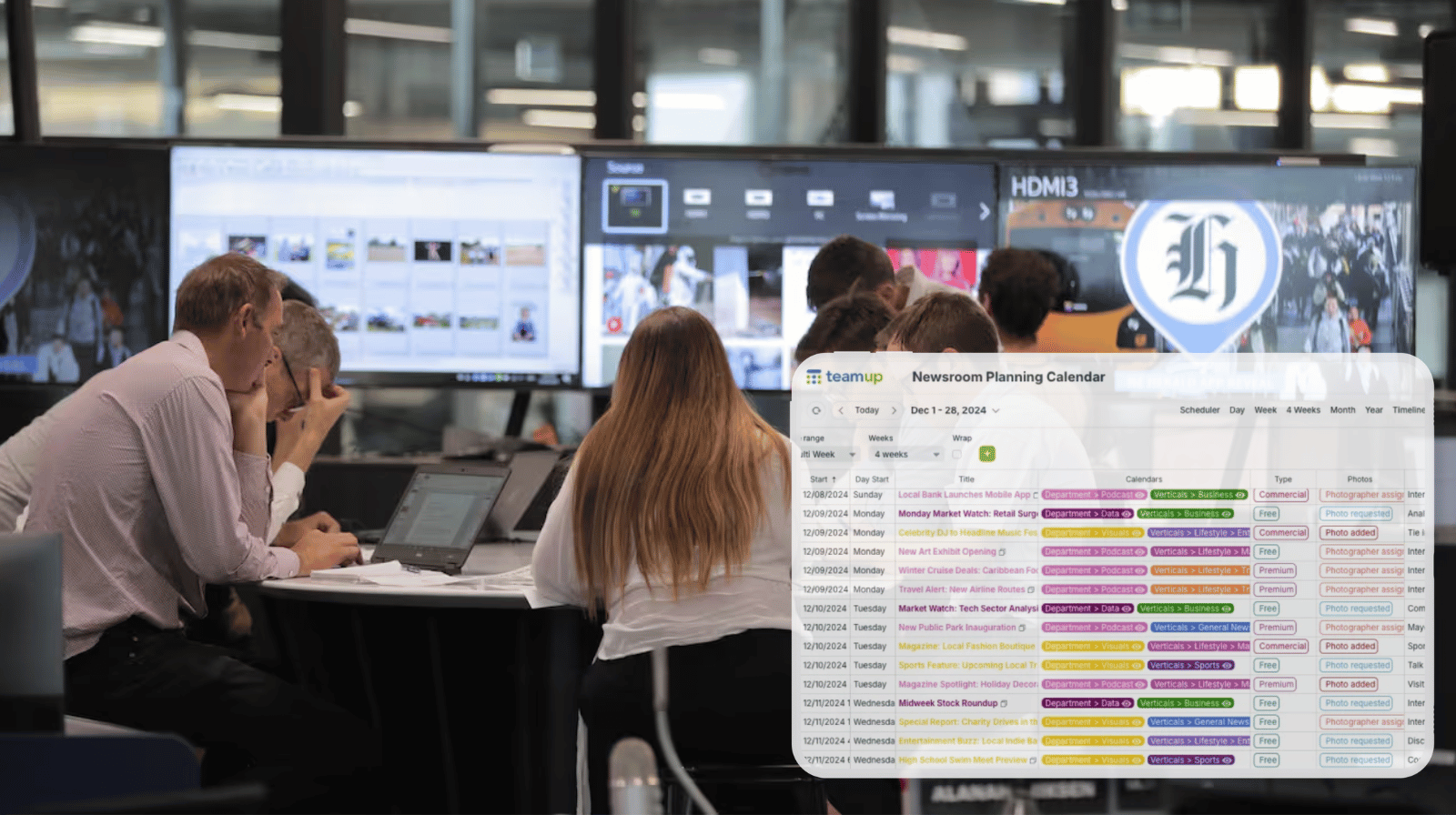
Teamup’s sub-calendar organization, color-coding, and folder features provided the much-needed visibility across all departments.
We use Teamup for two main things: First, for planning events we want to cover — what we call our diary. And second, for planning content we want to publish as a news organization. The main thing is being able to see what everybody’s doing at once. The design is clear and easy to read.
Nobody needs to be reading lists, making notes, and sending repetitive emails anymore. Every person just puts what they’re doing on the calendar. It’s visible across departments, including any relevant documents, files, or links that have been included on the assignment.
Easy onboarding, gradual growth
As far as onboarding, it was easy for people to start using Teamup.
You just spend five minutes showing somebody how to use Teamup, and everybody just picks it up. The shared calendar aspect, the nice, easy-to-use design, the fact that the functionality is so simple: Those are all big pluses for me.
Now, it’s been more than four years and counting and Teamup continues to serve this busy newsroom.
I see it as a long-term solution. It’s a system that is easy to start using quickly, and as it’s used we keep discovering more possibilities for what we need, like unique calendar views, notifications, and filtering.
Efficient resource use
Teamup has become an efficient way of organizing what the editors and reporters do at NZ Herald so they can plan efficient coverage and collaborate on exclusive content for their readers. A significant improvement came in resource management, particularly for the visual staff.
Teamup gives us the ability to be much more systematic and to deliver on what we plan to do. Before implementing Teamup, we had a major problem with booking photographers, videographers, and other visual staff. Now, with Teamup, it’s simple. It works just like a booking calendar.
Scalable collaboration
Teamup’s flexible structure allows 100+ users to be integrated while also allowing external access through shareable links as needed. The team has also eliminated a lot of wasted time spent on redundant emails and note-taking.
Many organizations waste a huge amount of time recycling and passing on information. With Teamup, we eliminate list reading, note-taking, and endless email chains. Everyone can just go in and bring themselves up to speed.
The disconnected silos are now connected in a single efficient system. With Teamup, departments can collaborate for streamlined editorial planning.
Ready to eliminate silos and simplify your workflow? Try Teamup today.