Client projects often rely on work from multiple teams, each using their own tools. Project managers end up chasing updates from different sources to keep an eye on the overall project progress. Here’s how a unified Teamup calendar can bring it all into a single project view, making coordination and project delivery smoother.
The need: Project managers need a reliable, up-to-date overview of how all departments contribute to a client project, including timing, dependencies, and handoffs.
The Teamup solution: A unified Teamup project calendar brings every departmental timeline into a single shared view, so progress, conflicts, and next steps are clearly visible on one page.
Why cross-team visibility matters
Client projects rarely stay within one team. A single delivery often spans multiple departments, each using its own tools and processes. This team automomy can be good for focus, but it can also create a fragmented project timeline. This leads to issues such as:
- Work stalling because a dependent task hasn’t started yet.
- Shared people or resources getting double-booked.
- Milestones drifting without early warning.
Project managers end up with a lot of extra work: checking status updates from each team, relaying dependencies, adjusting the timeline and sharing changes with each team individually to make sure everyone is aligned. With a shared project timeline across teams or departments, the process is streamlined. Teams can still operate independently, but everyone can see who is doing what, when their part starts, which tasks depend on others, when handoffs occur, and which deadlines are at risk. And the project manager has a clear overview of what’s happening across all teams and how it ties into the overall project.
Get a project overview with departmental organization
In Teamup, you can build a unified project calendar that keeps everything visible while giving each department the appropriate access permissions. Each department works in its own sub-calendar and manages its own updates, while the full project rolls up into one timeline for the project manager.
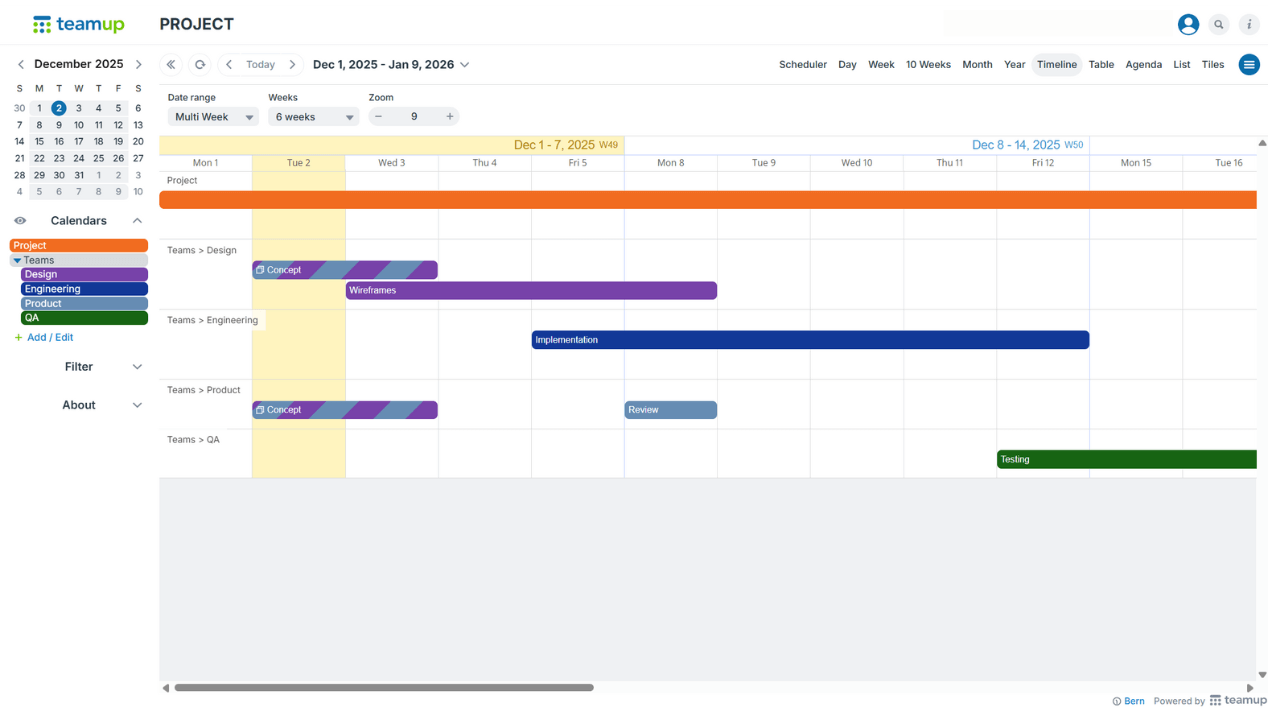
Click to enlarge: A Teamup project calendar showing color-coded sub-calendars per department.
For a closer look at how access levels and information visibility across internal teams, see how to Get Cross-Team Visibility with the Right Amount of Information Sharing.
The benefits of a unified project calendar
For project managers
- Gain the oversight they need without chasing updates.
- Easily spot delays, conflicts, or bottlenecks.
- Share filtered, read-only views with clients and stakeholders.
For departments
- See how their own schedule fits into the bigger project timeline.
- Improve collaboration across teams with clearer, shared context.
- Facilitate handoffs by having visibility into upstream and downstream work.
For leadership
- Gain a high-level view of how the project is progressing across departments.
- Spot broader risks and capacity constraints earlier.
- Enable clearer, more reliable long-range planning.
Example: A cross-department, shared project calendar
Many client projects follow a sequence such as Design, Development, QA, Customer handoff, and Launch. In a unified shared calendar, the entire sequence becomes visible in one place.
For example: Design can schedule concepts, wireframes, and approval cycles. Development can block time for implementation and internal reviews. QA can add testing windows and verification steps. At the end, Customer Success can schedule onboarding or handoff activities.
With all of these phases shown together in a single timeline, it becomes much easier to understand dependencies, spot risks early, and ensure each team is ready for the next handoff.
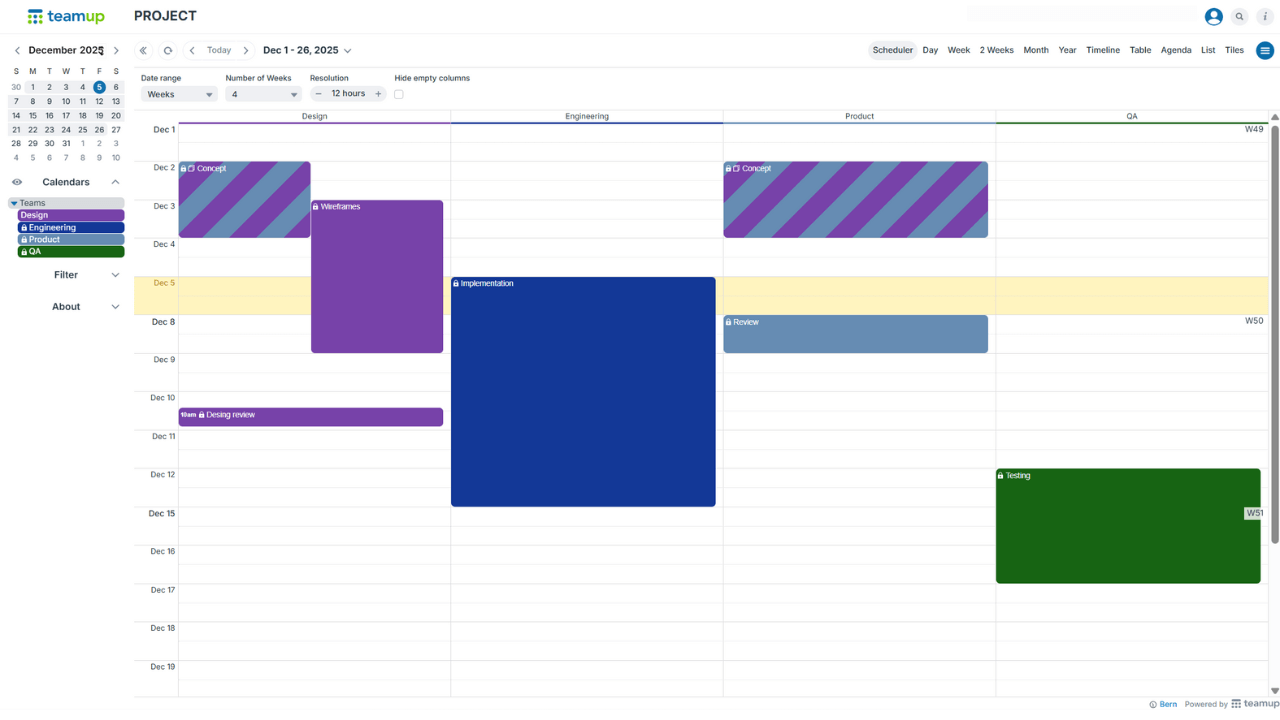
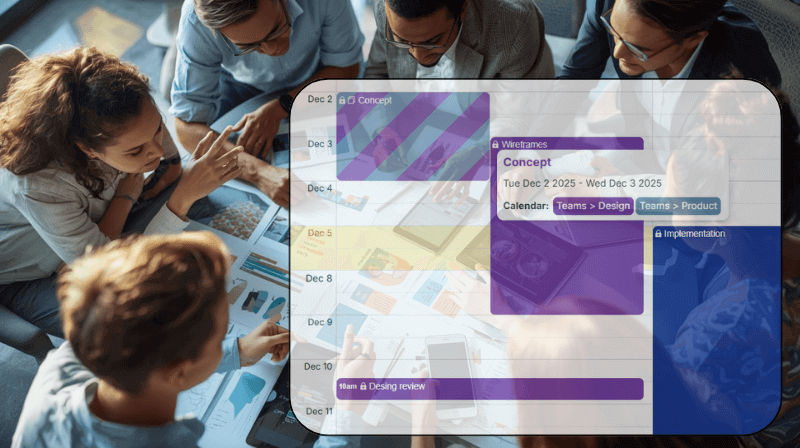
Click to enlarge: Design team Scheduler view. The lock icon next to the other department sub-calendars shows that events in other departments’ calendars are visible, but Read-Only.
Related resources
Ready to try a unified project calendar for your own team? Explore our live demos or create your own Teamup calendar.