
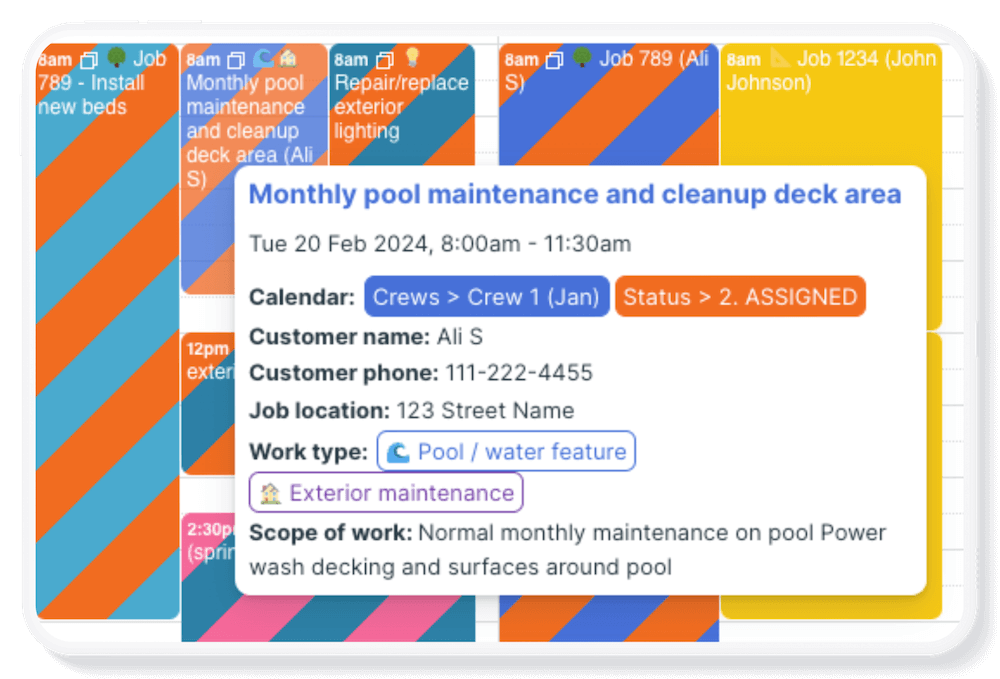
Using Custom Fields for More Organized Calendar Information

Custom fields can help structure and standardize the way information is organized on a calendar, allowing users to easily add information and find it back when it is needed.

Think about the different parts of any job or event in the real world. For instance, if you run a kitchen renovation service, you’d want your teams to see client contacts and phone numbers in their calendar job entries. If you’ve used spreadsheets to track projects, you can picture having one column for client names and another for phone numbers. Unlike traditional calendars with set fields, Teamup lets you rename these fields and create custom event fields, just like adding columns in a spreadsheet.

Here are some ways to configure custom fields to better organize job or event information, use workflows consistently, and make overall operations more streamlined and efficient.

Field types

For each custom field on Teamup, you can define it to be one of the four field types. Choose the field type based on the kind of information you need on the calendar. For example:

    • Use a single-line text field for short notes, keywords, phone number, email address, and links to websites, documents, job sites or meeting points.
    • Use a formatted text field for detailed descriptions, lengthy instructions, internal notes, or summaries.
    • Use a number field for dollar amounts, hour estimates, prices, weights, ,o;es or number of pages or words.
    • Use a choice field for status updates, ratings, booking options, requirements, and event types, etc..

Field labels

Make the field labels as descriptive as possible so they serve as cues for users. Clear, specific labels help guide users and reduce errors.
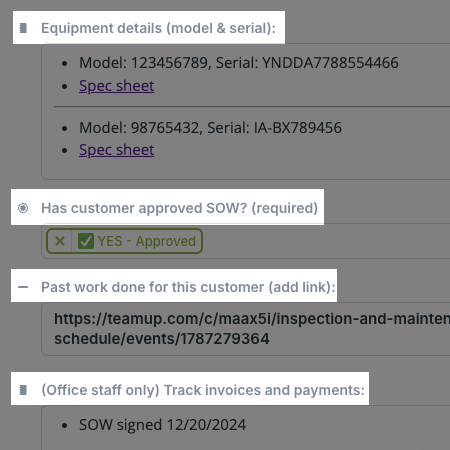
Use field labels to prompt users for the needed input.

Here are a few examples:

  • “Detailed description of work needed”
  • “Current task status”
  • “Dietary restrictions or allergies?”
  • “Estimated work hours”
  • “Input total invoice amount.”

You can also change labels on the default event fields to make them more useful: see how to do an event fields makeover.

Require essential details

Missing information can interrupt workflows in calendar events. To avoid this, you can set certain event fields as required. Users can’t create or modify events if a required field is left empty.
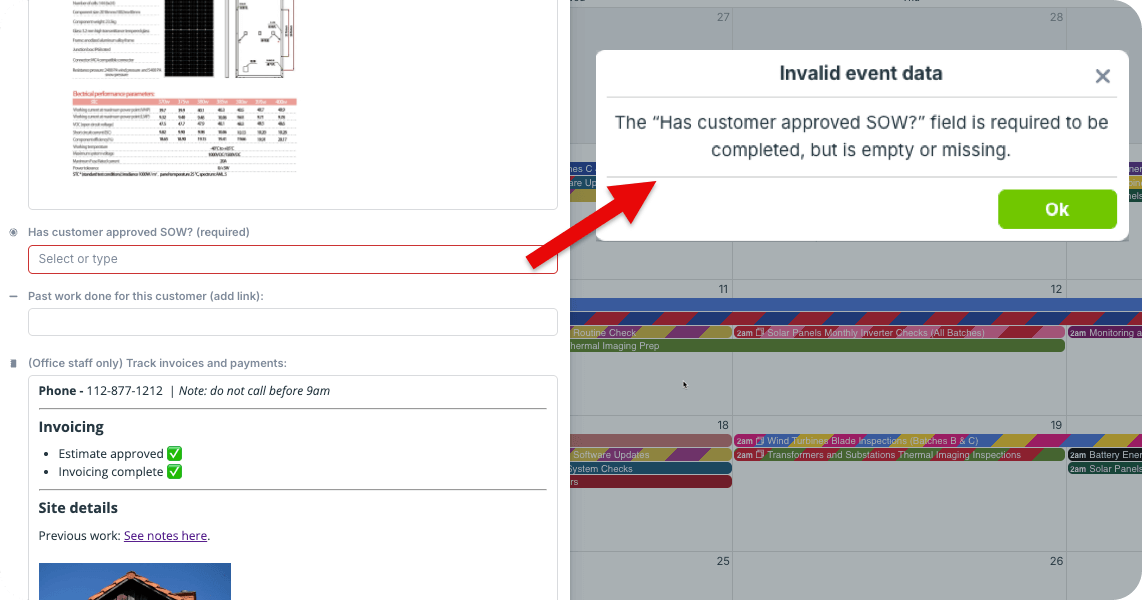
Required fields must have input or the event cannot be saved.

Required fields prevent users from skipping key details, ensuring consistency and better communication. For example:

  • Capture critical information like client contact details.
  • Keep workflows consistent by enforcing necessary steps.
  • Improve team communication with a required status field.
  • Ensure booking guidelines are followed with mandatory fields.

Provide visual cues

Visual cues make information easier to grasp and remember. Color-coding creates one type of visual cue. You can add another visual cue to the calendar by using symbols or color blocks, such as emojis.
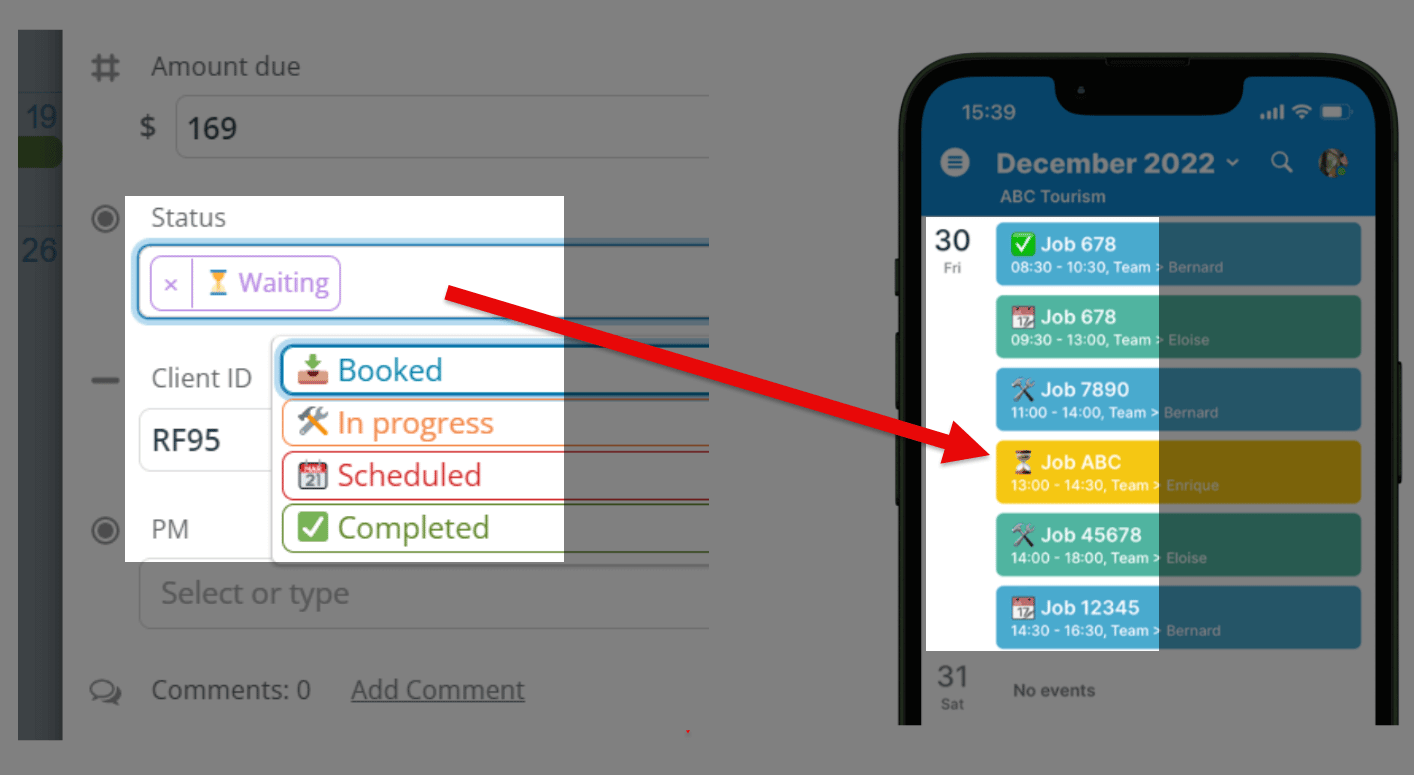
Visual cues give quick information at a glance on a browser or mobile.

These symbols can signify a certain event category, a task status, an assigned person, etc. They make it easy for users to glance at the calendar and process information quickly. That’s helpful when staff members are answering customer questions, looking for status updates, finding resource availability or trying to figure out who’s been assigned to a certain job.

To provide visual cues through symbols, assign an emoji to each option of a custom choice field and set it to show in the event title. The emojis are visible on a browser and on the Teamup app.


Color-Coding for Smarter Scheduling: A Cleaning Service’s Story

Color-Coding for Smarter Scheduling: A Cleaning Service’s Story

Client projects rarely stay within one team. A single delivery often spans multiple departments, each using its own tools and processes. Design creates concepts and assets in their design tools, development tracks build work in a sprint board, QA manages testing in their own environment, and customer success coordinates onboarding on a separate timeline.

Each team is doing solid work. But no one sees the whole project as it moves forward. As a result, project managers spend time chasing updates from every department and trying to piece together what’s happening. With Teamup, project managers can create a unified calendar structure to coordinate complex, multi-department client projects with full transparency, fewer surprises, and smoother delivery.

Why cross-team visibility matters

When every department tracks its work in its own system, the overall project timeline becomes fragmented. This leads to issues such as:

Work stalling because a dependent task hasn’t started yet
Shared people or resources getting double-booked
Milestones drifting without early warning

Project managers constantly need to update status between teams just to keep everyone aligned. But with a shared timeline, everyone can easily see: Who is doing what, when their part starts, which tasks depend on others, when handoffs occur, which deadlines are at risk. With one shared calendar, the full delivery timeline is visible at a glance, improving coordination and efficiency across all teams.

A combined project calendar with departmental sub-calendars

In Teamup, you can build a unified project calendar that keeps everything visible while giving each department the appropriate access permissions. Each department works in its own sub-calendar and manages its own updates, while the full project rolls up into one timeline for the project manager.

Click to enlarge: A Teamup project calendar showing color-coded sub-calendars per department

For a closer look at how access levels and information visibility across internal teams, see how to Get Cross-Team Visibility with the Right Amount of Information Sharing.

The benefits of a unified project calendar
For project managers
Gain the oversight they need without chasing updates.
Easily spot delays, conflicts, or bottlenecks.
Share filtered, read-only views with clients and stakeholders.
For departments
See how their own schedule fits into the bigger project timeline.
Improve collaboration across teams with clearer, shared context.
Facilitate handoffs by having visibility into upstream and downstream work.
For leadership
Gain a high-level view of how the project is progressing across departments.
Spot broader risks and capacity constraints earlier.
Enable clearer, more reliable long-range planning.
Example: A cross-department project timeline in a shared calendar

Many client projects follow a sequence such as Design, Development, QA, Customer handoff, and Launch. In a unified shared calendar, the entire sequence becomes visible in one place.

For example: Design can schedule concepts, wireframes, and approval cycles. Development can block time for implementation and internal reviews. QA can add testing windows and verification steps. At the end, Customer Success can schedule onboarding or handoff activities.

With all of these phases shown together in a single timeline, it becomes much easier to understand dependencies, spot risks early, and ensure each team is ready for the next handoff —  keeping the entire project moving forward smoothly.

Click to enlarge: Design team Scheduler view. The lock icon next to the other department sub-calendars shows that events in other departments’ calendars are visible, but Read-Only

Ready to try a unified project calendar for your own team? Explore our live demos or create your own Teamup calendar.

WordPress Cookie Notice by Real Cookie Banner