

Current Time in Cities Around the World

Instantly see and convert current time in any location

  • The current time of the selected world cities demonstrates how current time is displayed on a Teamup Calendar.
  • Time zone conversion is completed automatically when you choose a different time zone in the bottom right.
  • All the events on your Teamup Calendar will be automatically converted to the time of the time zone displayed in the bottom right.
  • Daylight Saving Time changes in all locations are automatically reflected when the time is displayed on your calendar.
Cou

ntry Code

Time zone ID Current time
AU Australia/Adelaide Adelaide
NZ Pacific/Auckland Auckland
TH Asia/Bangkok Bangkok
DE Europe/Berlin Berlin
US US/Mountain Boulder
AU Australia/Queensland Brisbane
AR America/Argentina/Buenos_Aires Buenos Aires
EG Africa/Cairo Cairo
DK Europe/Copenhagen Copenhagen
AE Asia/Dubai Dubai
IE Europe/Dublin Dublin
US US/Hawaii Hawaii
FI Europe/Helsinki Helsinki
HK Hongkong Hongkong
US US/Central Chicago
IS Iceland Iceland
ID Asia/Jakarta Jakarta
ZA Africa/Johannesburg
UA Europe/Kyiv Kyiv
NG Africa/Lagos Lagos
PE America/Lima Lima
PT Europe/Lisbon Lisbon
GB Europe/London London
US America/Los_Angeles Los Angeles
ES Europe/Madrid Madrid
AU Australia/Victoria Melbourne
MX America/Mexico_City Mexico City
IN Asia/Kolkata New Delhi
US US/Eastern New York
NO Europe/Oslo Oslo
FR Europe/Paris Paris
AU Australia/Perth Perth
CZ Europe/Prague Prague
PR America/Puerto_Rico Puerto Rico
IT Europe/Rome Rome
US US/Pacific
JM America/Costa_Rica
BR America/Sao_Paulo Sao Paulo
KR Asia/Seoul Seoul
CN Asia/Shanghai Shanghai
SG Asia/Singapore Singapore
SE Europe/Stockholm Stockholm
AU Australia/Sydney Sydney
JP Asia/Tokyo Tokyo
CA America/Toronto Toronto
AT Europe/Vienna Vienna
PL Europe/Warsaw Warsaw
CH Europe/Zurich Zurich


Change time zone and see current time in other locations

You can also open this calendar and select any time zone to see the current time in that location: Click the time zone indicator at the bottom right and select the time zone of your choice.
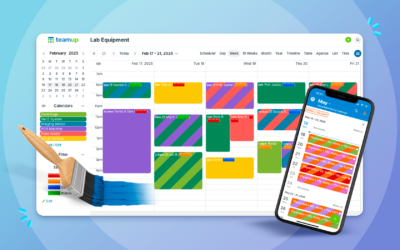

Color-Coding for Smarter Scheduling: A Cleaning Service’s Story

Color-Coding for Smarter Scheduling: A Cleaning Service’s Story

Client projects rarely stay within one team. A single delivery often spans multiple departments, each using its own tools and processes. Design creates concepts and assets in their design tools, development tracks build work in a sprint board, QA manages testing in their own environment, and customer success coordinates onboarding on a separate timeline.

Each team is doing solid work. But no one sees the whole project as it moves forward. As a result, project managers spend time chasing updates from every department and trying to piece together what’s happening. With Teamup, project managers can create a unified calendar structure to coordinate complex, multi-department client projects with full transparency, fewer surprises, and smoother delivery.

Why cross-team visibility matters

When every department tracks its work in its own system, the overall project timeline becomes fragmented. This leads to issues such as:

Work stalling because a dependent task hasn’t started yet
Shared people or resources getting double-booked
Milestones drifting without early warning

Project managers constantly need to update status between teams just to keep everyone aligned. But with a shared timeline, everyone can easily see: Who is doing what, when their part starts, which tasks depend on others, when handoffs occur, which deadlines are at risk. With one shared calendar, the full delivery timeline is visible at a glance, improving coordination and efficiency across all teams.

A combined project calendar with departmental sub-calendars

In Teamup, you can build a unified project calendar that keeps everything visible while giving each department the appropriate access permissions. Each department works in its own sub-calendar and manages its own updates, while the full project rolls up into one timeline for the project manager.

Click to enlarge: A Teamup project calendar showing color-coded sub-calendars per department

For a closer look at how access levels and information visibility across internal teams, see how to Get Cross-Team Visibility with the Right Amount of Information Sharing.

The benefits of a unified project calendar
For project managers
Gain the oversight they need without chasing updates.
Easily spot delays, conflicts, or bottlenecks.
Share filtered, read-only views with clients and stakeholders.
For departments
See how their own schedule fits into the bigger project timeline.
Improve collaboration across teams with clearer, shared context.
Facilitate handoffs by having visibility into upstream and downstream work.
For leadership
Gain a high-level view of how the project is progressing across departments.
Spot broader risks and capacity constraints earlier.
Enable clearer, more reliable long-range planning.
Example: A cross-department project timeline in a shared calendar

Many client projects follow a sequence such as Design, Development, QA, Customer handoff, and Launch. In a unified shared calendar, the entire sequence becomes visible in one place.

For example: Design can schedule concepts, wireframes, and approval cycles. Development can block time for implementation and internal reviews. QA can add testing windows and verification steps. At the end, Customer Success can schedule onboarding or handoff activities.

With all of these phases shown together in a single timeline, it becomes much easier to understand dependencies, spot risks early, and ensure each team is ready for the next handoff —  keeping the entire project moving forward smoothly.

Click to enlarge: Design team Scheduler view. The lock icon next to the other department sub-calendars shows that events in other departments’ calendars are visible, but Read-Only

Ready to try a unified project calendar for your own team? Explore our live demos or create your own Teamup calendar.

WordPress Cookie Notice by Real Cookie Banner